
Search Hawaii Divorce Decree Records
Hawaii divorce decree records are court documents filed with the Family Court in the circuit where the case was heard. The state is divided into four active judicial circuits, each covering one or more islands. If you need to find a Hawaii divorce decree, confirm a dissolution took place, or get copies of court filings, you can search online through the Hawaii State Judiciary or contact the Family Court clerk in the county where the case was filed. This guide covers how to search Hawaii divorce decree records, what those records contain, and how to request the documents you need.
Hawaii Divorce Decree Overview
Where to Find Hawaii Divorce Decree Records
In Hawaii, all divorces are filed with the Family Court. There is no single statewide office that holds all divorce decrees. The court in the circuit where the divorce was filed keeps the complete case file. To get a Hawaii divorce decree or check on a dissolution case, you need to contact the right circuit. The state has four active judicial circuits: the First Circuit on Oahu, the Second Circuit covering Maui, Molokai, and Lanai, the Third Circuit on Hawaii Island, and the Fifth Circuit on Kauai. Kalawao County has no court of its own, so its cases go through the Second Circuit in Wailuku.
The Hawaii Department of Health historically kept divorce certificates from 1951 through December 2002. As of February 1, 2026, the DOH no longer maintains any divorce records. That means the DOH cannot help you with divorce decree requests of any kind going forward. For divorce decrees from any year, you must now contact the Family Court clerk in the circuit where the case was filed. The DOH at health.hawaii.gov/vitalrecords still handles birth, death, and marriage records, but divorce is handled exclusively through the courts.
For very old records, the Hawaii State Archives is another resource. The Archives holds historical Hawaii judiciary records from 1839 through 1970. Divorce case files from each circuit are microfilmed and cataloged. The First Circuit files cover 1848 to 1892 and contain cases 1 through 2415. Second Circuit files run from 1848 to 1900. Third Circuit files cover 1854 to 1899. Fifth Circuit divorce files are available from 1851 to 1914. The Hawaii State Archives is located at 364 S. King Street, Honolulu.
Note: As of February 1, 2026, the Hawaii Department of Health no longer maintains divorce records. All Hawaii divorce decree requests must go directly to the Family Court in the circuit where the divorce was filed.
Searching Hawaii Divorce Records Online
The fastest way to look up a Hawaii divorce decree online is through eCourt Kokua. This is the Hawaii State Judiciary's public case search system. You can access it at courts.state.hi.us. The system covers traffic cases, District Court and Circuit Court criminal and civil matters, Family Court civil cases, Land Court, Tax Appeal Court, and appellate cases. It is free to use.
To search for a divorce decree in eCourt Kokua, select the appropriate circuit from the search options. Then choose the Family Court case type and search by party name. You can also search by case number if you have it. Results show the names of the parties, the case type, the filing date, the current case status, and a list of docket entries. The system does not provide full document images in most cases. Certified paper copies of a divorce decree are only available at the courthouse.
eCourt Kokua does not contain every court record. Confidential cases and sealed documents are not visible in public searches. The system is updated each evening, so information is generally current to within 48 hours of the most recent court activity.
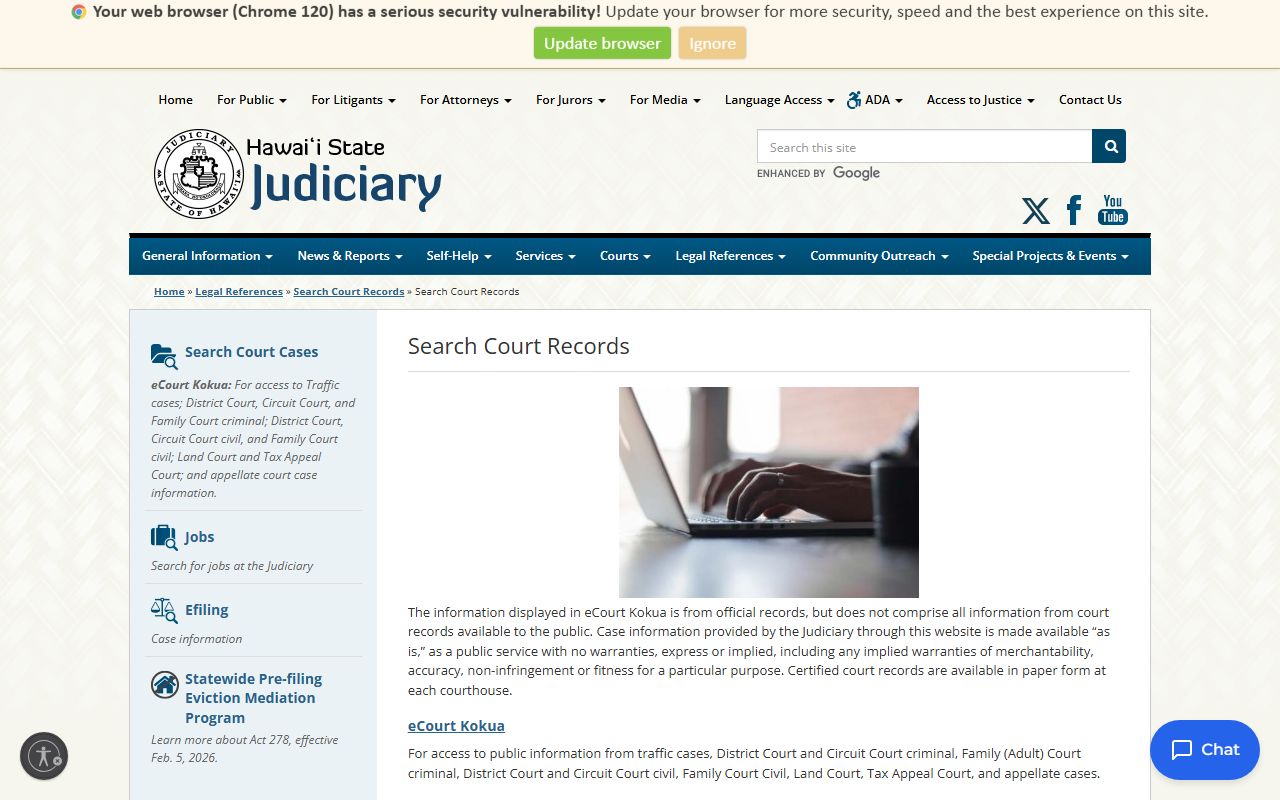
The eCourt Kokua system gives you public access to Hawaii divorce case information by party name or case number. The University of Hawaii's library guide for Hawaii court records offers additional tips on using the system and finding older records through archives and microfilm collections.
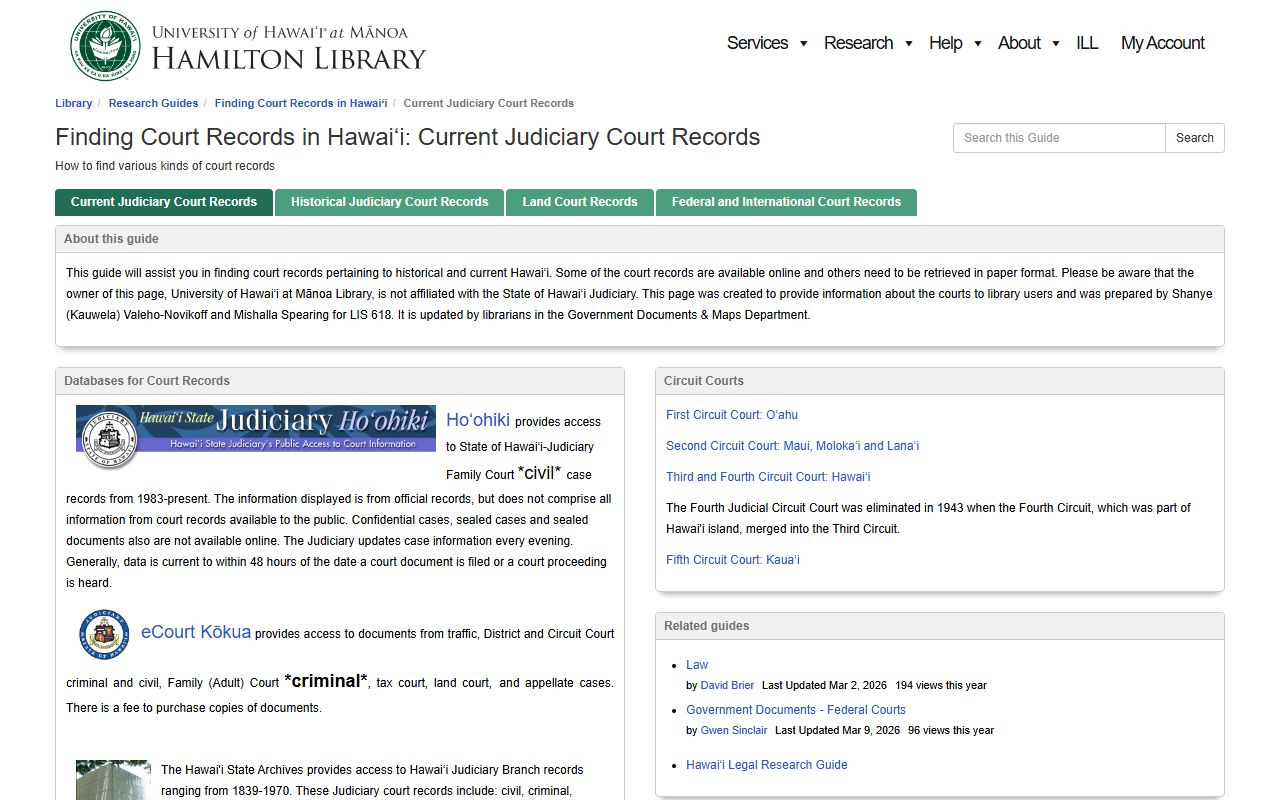
The UH Manoa Library guide explains how Ho'ohiki, eCourt Kokua, the State Archives, and the Judiciary History Center all fit together when you are tracking down older Hawaii divorce records. It is a useful starting point if the online system doesn't have what you need.
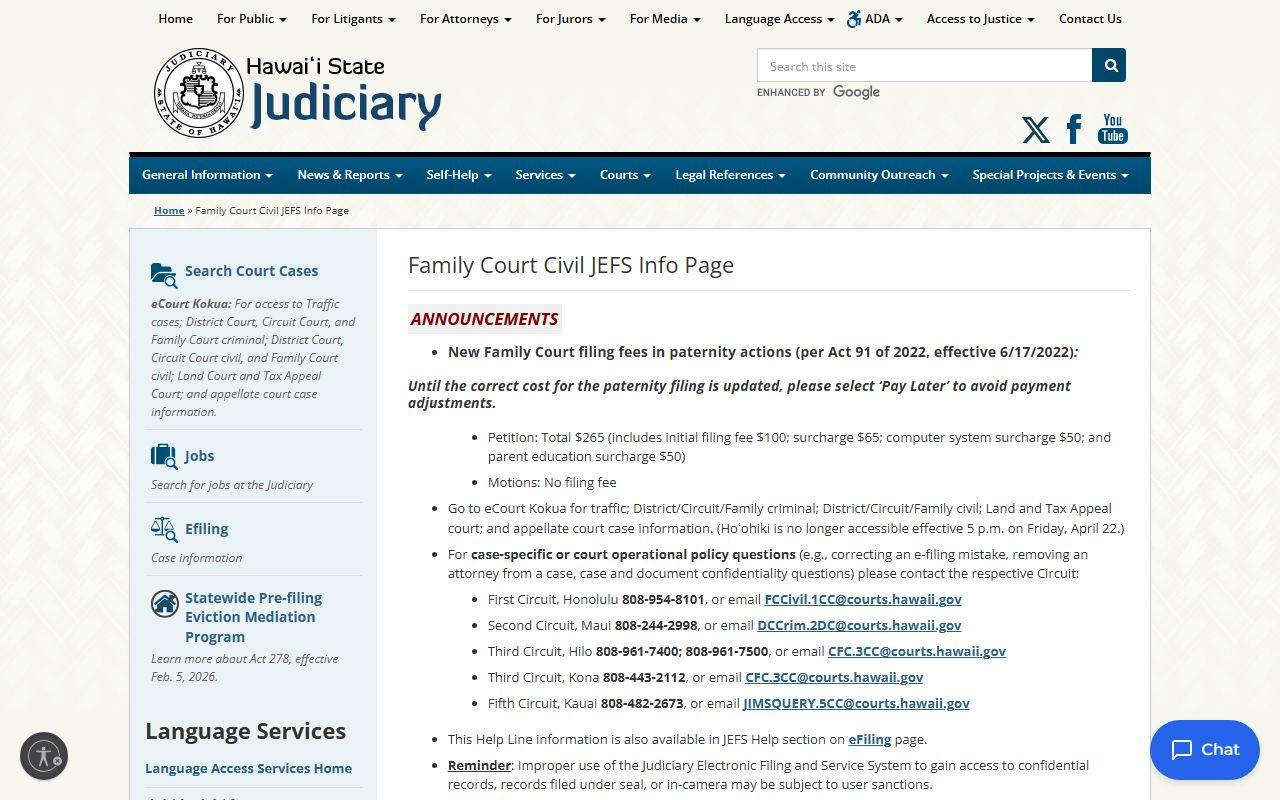
The Judiciary Electronic Filing and Service System, known as JEFS, is the e-filing platform used by attorneys and registered filers. If you have questions about a specific filing or need to contact a circuit about a case, each circuit has its own JEFS contact. You can reach the JEFS info page for full contact details by circuit.
What a Hawaii Divorce Decree Contains
A divorce decree is the court order that ends a marriage in Hawaii. A judge signs it once both parties have resolved all issues or after a trial. The decree sets out the terms of the dissolution: how property is divided, who has custody of the children, what the support amounts are, and any name change. Once a judge signs and the case is finalized, the marriage is legally over. That signed decree is what most people need when they have to prove their marital status later on.
A full divorce case file at the Family Court clerk's office typically holds the Complaint for Divorce with its Automatic Restraining Order and Summons, the Matrimonial Action Information form, any Appearance and Waiver signed by the other spouse, the Income and Expense Statement, the Asset and Debt Statement, and the final signed Divorce Decree. Cases involving children also include the parenting plan, any temporary orders for custody or support, and documentation for the Kids First program. The Family Court forms page at courts.state.hi.us lists all standard forms used in Hawaii divorce cases by circuit.
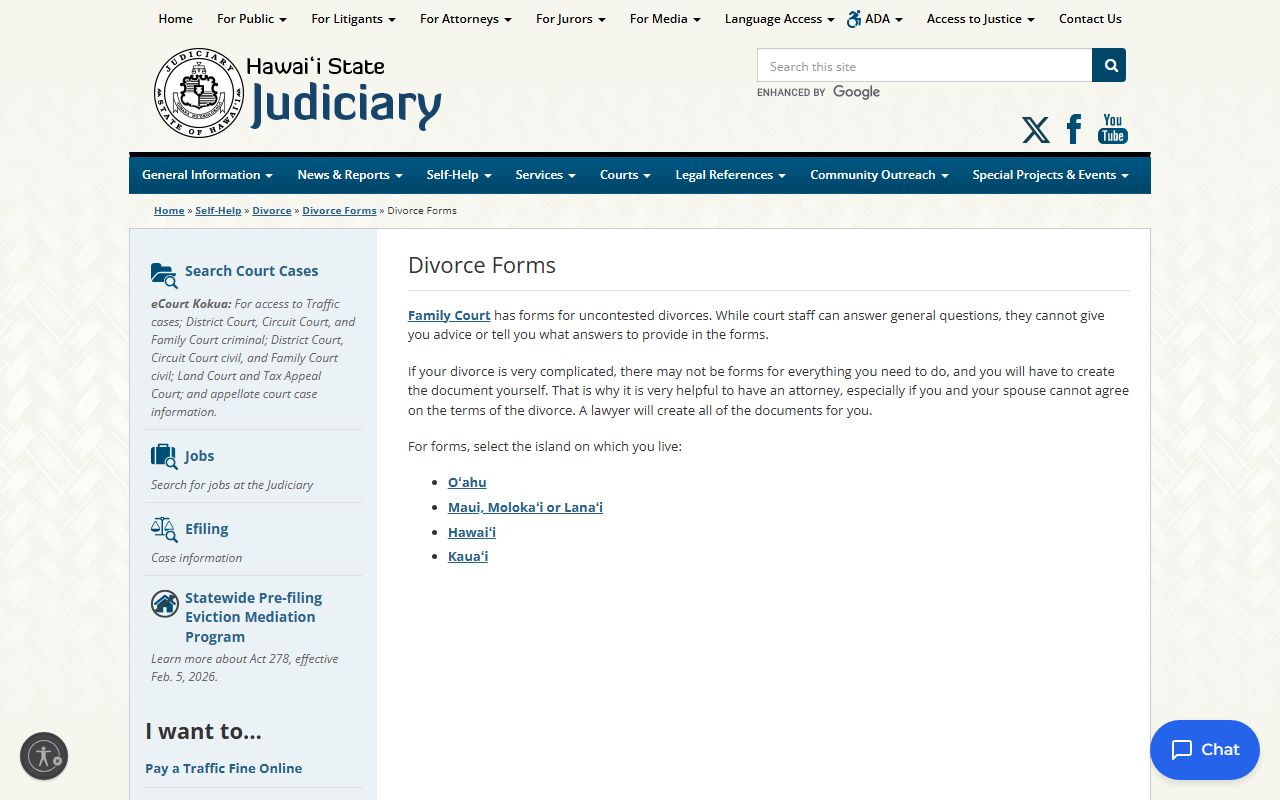
The Hawaii divorce forms page organizes forms by island circuit. Each circuit uses its own version of the standard documents. Oahu uses Form 1F-P-1056 as the Divorce Decree for cases without children. The Third Circuit on Hawaii Island uses Form 3FP260 for proposed divorce decrees with children.
Most divorce records at the Family Court clerk's office are open to the public. You do not have to be one of the parties to request copies. Some financial source documents and child custody evaluations may have restricted access. The court can seal specific records if a party shows good cause, but this is not routine.
Hawaii Divorce Law and the Divorce Decree
Under HRS § 580-1, the Family Court in each circuit has exclusive original jurisdiction over divorce cases. To file in a circuit, at least one spouse must have been domiciled or physically present in Hawaii for six continuous months before filing. That spouse must also have been present in the specific circuit for at least three months. Military members stationed in Hawaii on orders are not barred from meeting these requirements.
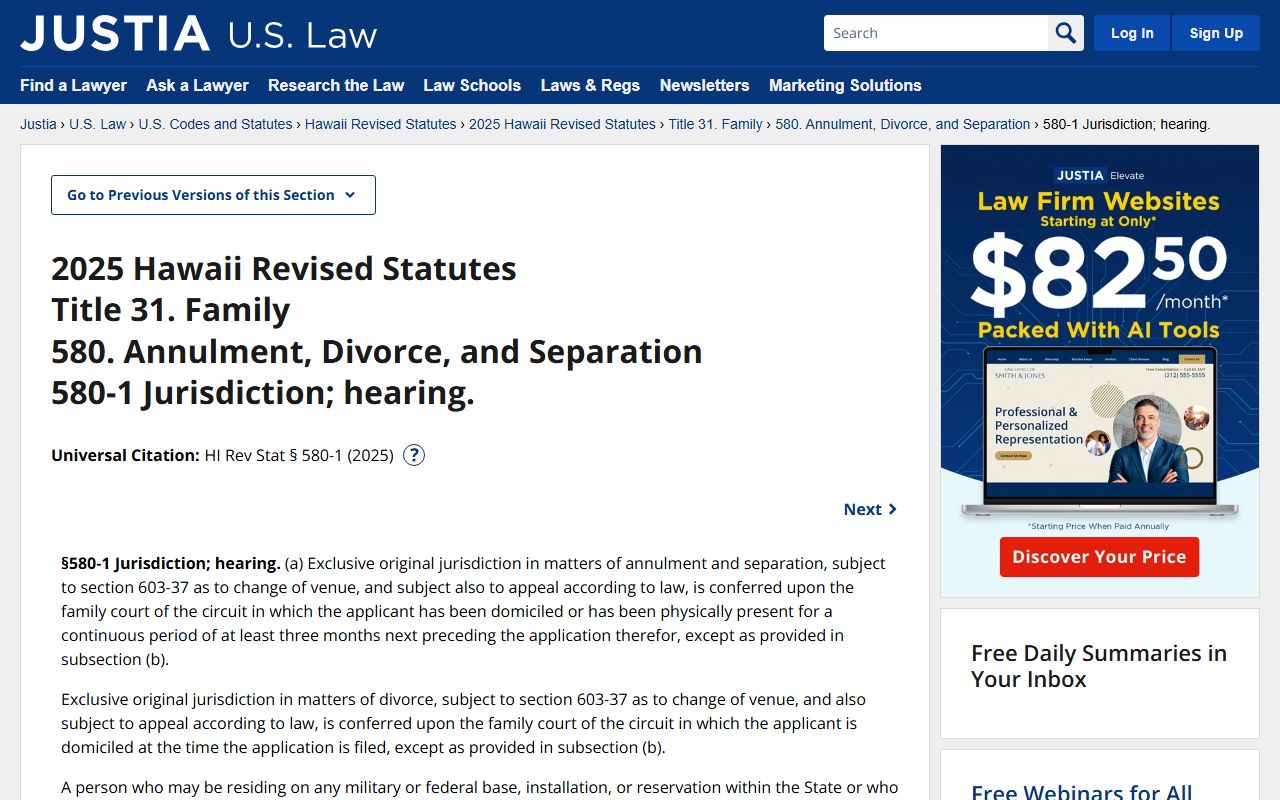
HRS § 580-1 also allows couples married in other states or countries to get divorced in Hawaii. The key is that one spouse meets the residency requirements for the circuit where the complaint is filed.
Hawaii is a strict no-fault divorce state. Under HRS § 580-41, the court grants a divorce when it finds that the marriage is irretrievably broken, that the parties have lived separate and apart for two or more continuous years, or that a separation decree has been in effect for two years or more. Fault grounds like adultery, cruelty, or abandonment are not recognized in Hawaii. Marital misconduct does not affect property division or who gets spousal support.
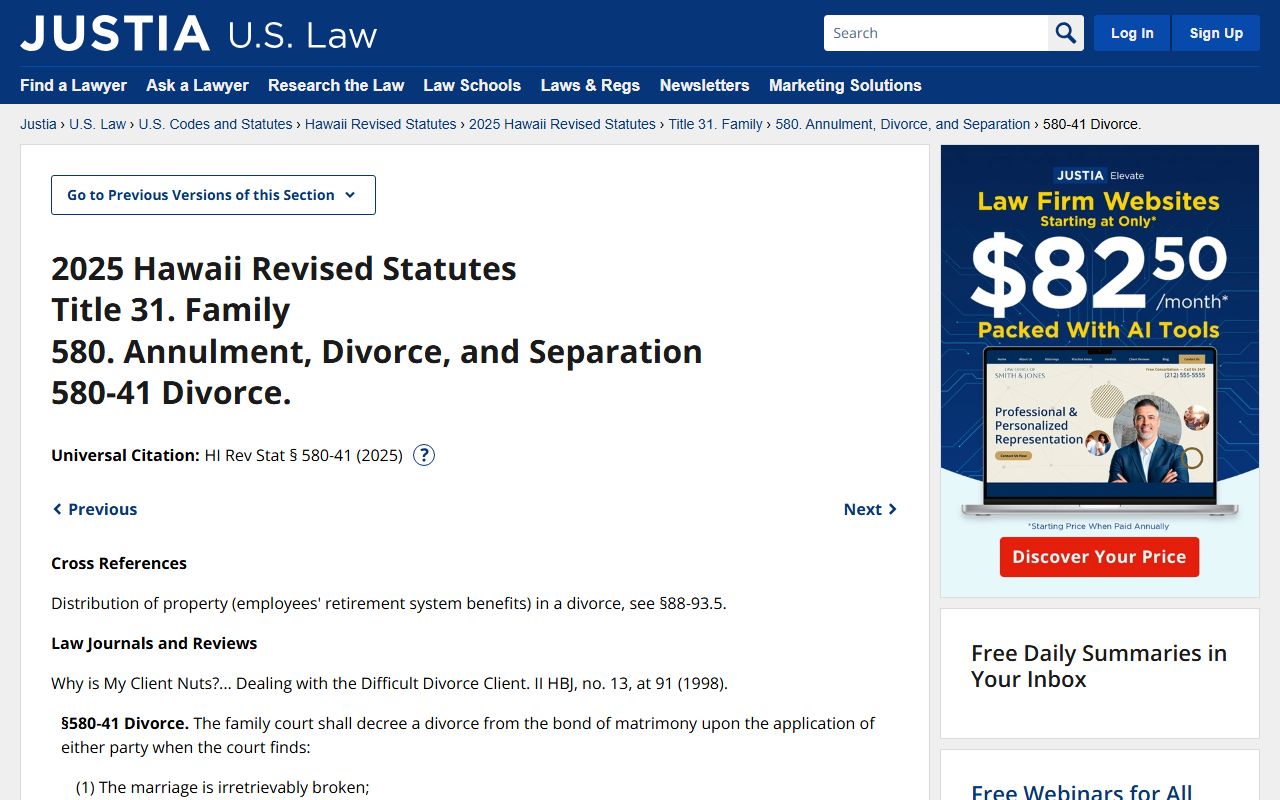
The statute at HRS § 580-41 makes Hawaii one of the cleaner no-fault states. You do not have to prove fault or wait for a separation period. If the marriage is irretrievably broken, either spouse can file. The court does not require mutual agreement to grant the divorce.
HRS § 580-47 governs spousal support and property division. When ordering maintenance, the court considers the financial resources of each party, the ability of the requesting spouse to meet their own needs, the duration of the marriage, the standard of living during the marriage, the age and physical condition of both parties, and the vocational skills of the spouse seeking support. The Hawaii Supreme Court has consistently held that HRS § 580-47 gives the Family Court wide discretion in these decisions. Property and support terms become part of the final divorce decree once the court enters its order.
Public access to Hawaii court records, including divorce decrees, is governed by the Uniform Information Practices Act. The UIPA, codified at HRS Chapter 92F, declares that all government records are open to public inspection unless restricted by law. The policy is transparency. Divorce case files fall under this framework, which means most documents in a divorce case are available to any member of the public who asks the court clerk.
How Hawaii Family Courts Handle Divorce
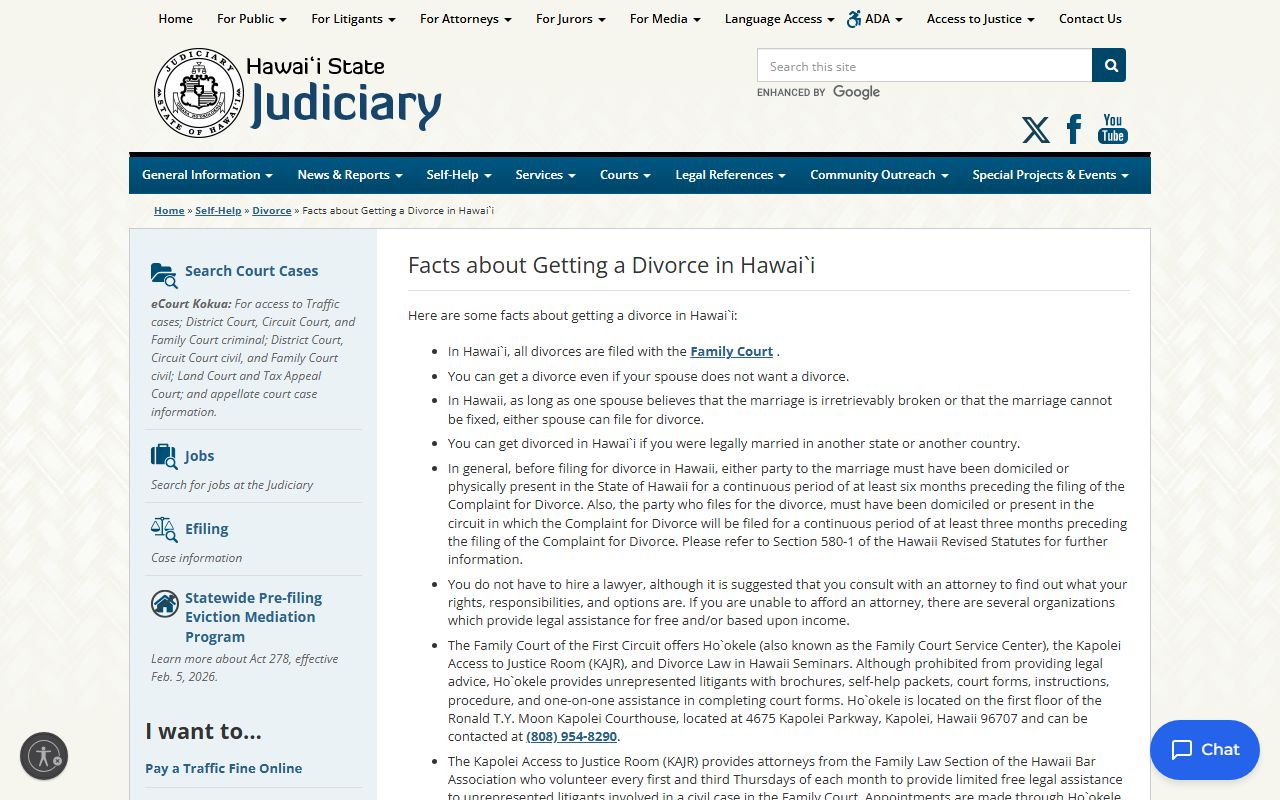
The Hawaii Judiciary divorce facts page explains the basics of the divorce process for each circuit. It covers who can file, what forms to use, how long the process takes, and where to go for help. A divorce in Hawaii typically takes several months. Cases involving disagreements over children or property take longer than uncontested ones.
You do not have to hire a lawyer to file for divorce in Hawaii. The courts encourage consulting with an attorney to understand your rights, but it is not required. Self-represented litigants can use the same forms and processes as represented parties. Hawaii Family Court staff can answer general questions about forms and procedures, though they cannot give legal advice or tell you what answers to provide.
If your case involves minor children and you file on Oahu, attendance at the Kids First program is mandatory. Kids First is designed to help parents understand the effects of divorce on children and to help families cope with the changes. The Oahu program is at 954-8280 and has a website at kidsfirsthawaii.com. Maui's Kids First contact is (808) 244-2770, and the Hilo program is at (808) 896-6465. A divorce may be denied until this requirement is met in cases where it applies.
Getting Copies of a Hawaii Divorce Decree
To get a copy of a Hawaii divorce decree, contact the Family Court clerk in the circuit where the case was filed. You can visit in person, write a request by mail, or in some cases request through eCourt Kokua. In-person requests are often handled the same day if the file is readily available. Mail requests typically take one to two weeks depending on the court's workload.
When you visit the courthouse in person, bring a valid government-issued ID. Have the names of the parties and the approximate year of filing ready. The case number helps, but the clerk can search by party name if you don't have it. For a mail request, include a written request letter with the case details, a photocopy of your ID, a self-addressed stamped envelope, and payment for copy fees. Payment must be by money order or cashier's check made payable to State Director of Finance. Personal checks may not be accepted, and do not send cash.
Copy fees in Hawaii courts are set under HRS § 607-5. Standard copies cost $1.00 per page. Certified copies cost an additional $2.00 per document on top of the per-page cost. A record search by name costs $5.00 per name. Expedited requests may carry an additional $10.00 fee. These rates can vary slightly by circuit, so contact the clerk before you go to confirm current costs.
For each circuit, the mail request addresses are:
- First Circuit (Oahu): 777 Punchbowl Street, Honolulu, HI 96813
- Second Circuit (Maui): Hoapili Hale, 2145 Main Street, Wailuku, HI 96793
- Third Circuit (Hilo): Hale Kaulike, 777 Kilauea Avenue, Hilo, HI 96720
- Third Circuit (Kona): Keakealani Building, 79-1020 Haukapila Street, Kealakekua, HI 96750
- Fifth Circuit (Kauai): 3970 Ka'ana Street, Lihue, HI 96766
For historical divorces from 1951 through December 2002, the Department of Health previously issued divorce certificates. That service ended as of February 1, 2026. If you need records from that period, contact the Family Court directly for the circuit that handled the case. The State Archives at ags.hawaii.gov is your resource for cases older than what eCourt Kokua covers, particularly those filed before 1900.
Hawaii Department of Health and Divorce Records
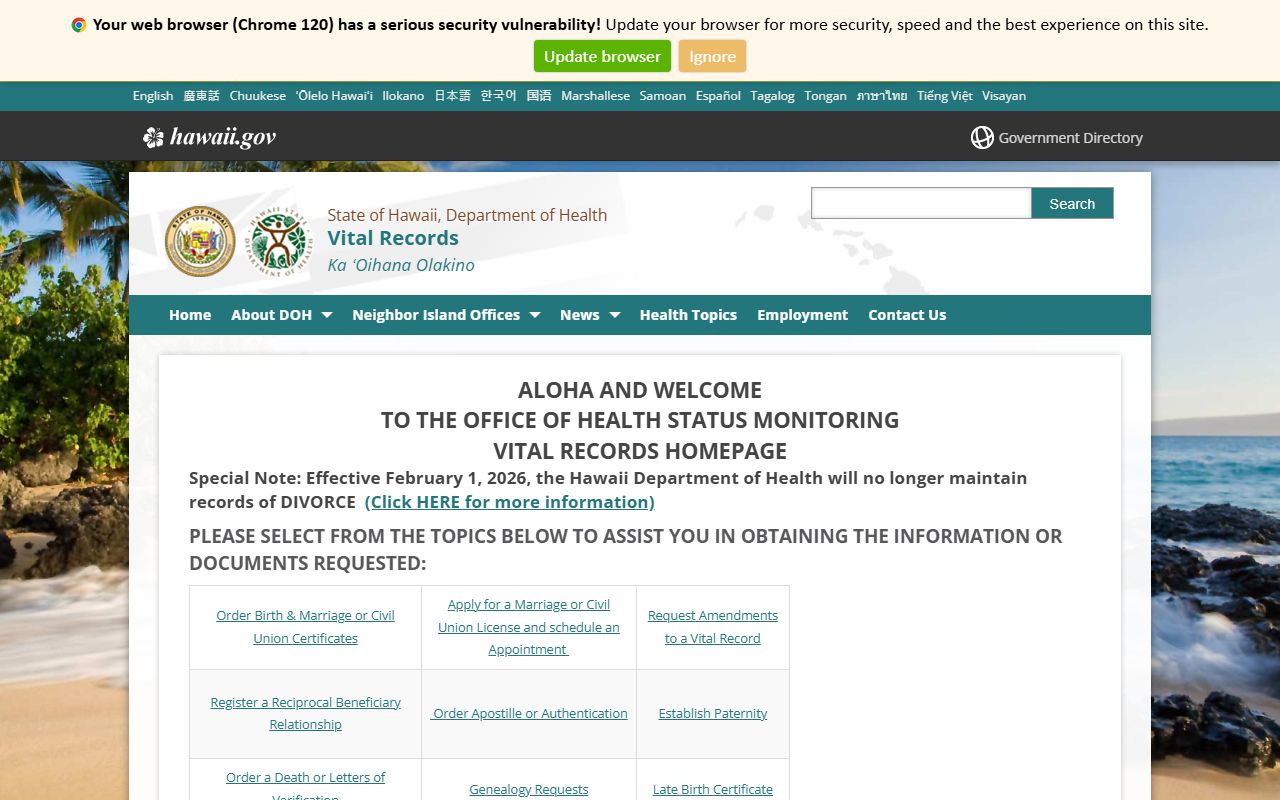
The Hawaii Department of Health Vital Records office is located at 1250 Punchbowl Street, Room 103, Honolulu. Hours are Monday through Friday, 7:45 a.m. to 2:30 p.m. As of February 1, 2026, the DOH no longer maintains divorce records. The DOH still handles birth, marriage, civil union, and death records, but any request related to a divorce decree must now go through the appropriate Family Court.
For neighbors islands, the DOH has district health offices. The Big Island office is at 75 Aupuni Street, Suite 201, Hilo, phone (808) 974-6008. Kauai residents can contact the Kauai District Health Office at 3040 Umi Street, Lihue, (808) 241-3498. These offices no longer assist with divorce records either, consistent with the statewide policy change.
Legal Help and Self-Help Resources in Hawaii
Several organizations offer free or low-cost legal help with divorce in Hawaii. The Legal Aid Society of Hawaii (LASH) provides legal assistance to those who qualify based on income. LASH can be reached at (808) 536-4302. The Volunteer Legal Services Hawaii (VLSH) runs legal advice clinics, brief services, and referrals to pro bono attorneys for those who qualify based on income and legal issue. VLSH is at (808) 528-7046. On Maui, the Legal Aid Society office is at 24 North Church Street, Suite 401, Wailuku, (808) 244-3731. On Kauai, the Legal Aid office is at 3016 Umi Street, Suite 208, Lihue, (808) 245-4728.
The Family Court of the First Circuit on Oahu has two free self-help resources. Ho'okele, also known as the Family Court Service Center, is located on the first floor of the Ronald T.Y. Moon Kapolei Courthouse at 4675 Kapolei Parkway, Kapolei. Phone is (808) 954-8290. Ho'okele staff can provide brochures, self-help packets, court forms, instructions, and one-on-one help filling out forms. They cannot give legal advice. The Kapolei Access to Justice Room provides volunteer Family Law attorneys from the Hawaii Bar Association every first and third Thursday of each month, 11:30 a.m. to 1:30 p.m., for free limited legal consultations. Appointments are made through Ho'okele at the same number.
The Divorce Law in Hawaii seminar is a free monthly informational session at the Kapolei Courthouse. It covers the law and process of divorce, settlement options, and ways to reduce conflict and expense. On the other islands, each circuit has a self-help center. The Maui self-help center at Hoapili Hale, 2145 Main Street, Wailuku, is open Thursdays 9 a.m. to noon, (808) 463-1360. The Hilo self-help center at Hale Kaulike, 777 Kilauea Avenue, is open Tuesdays and Fridays 11:15 a.m. to 12:45 p.m., (808) 961-0609, walk-in only. The Kona self-help desk at the Kona Courthouse is open Wednesdays 11 a.m. to 1 p.m. The Legal Aid Society of Hawaii website has additional resources for self-represented litigants.
Note: Court staff can answer general questions about forms and procedures but cannot give legal advice. For guidance on your specific situation, contact the Legal Aid Society of Hawaii at (808) 536-4302 or Volunteer Legal Services Hawaii at (808) 528-7046.
Are Hawaii Divorce Decrees Public Records
Yes. Hawaii court records, including divorce decrees, are generally open to the public under HRS Chapter 92F, the Uniform Information Practices Act. You do not have to be one of the parties to the case. You don't need to give a reason for your request. The UIPA's core principle is that government records are open unless restricted by law.
Basic case information is accessible to anyone. That includes the names of the parties, the case number, the case type, the filing date, and general docket activity. The final divorce decree itself is typically accessible unless it has been sealed. Access to a complete decree or to sensitive documents such as financial statements, detailed asset inventories, and child custody evaluations may be limited to the parties and their attorneys. Social security numbers and financial account numbers are redacted from public filings. The court can seal specific documents if a party shows good cause, but judges rarely grant sealing requests in routine dissolution cases.
Browse Hawaii Divorce Decree Records by County
Each Hawaii county has a Family Court that keeps divorce decree records for cases filed in that circuit. Pick a county to find local contact details, courthouse locations, and resources for divorce records in that area.
Divorce Decree Records in Major Hawaii Cities
Hawaii residents file for divorce at the Family Court for their island circuit. Pick a city to find out which courthouse handles divorce records and how to access dissolution filings in that area.