
Kalawao County Divorce Decree Records
Kalawao County divorce decree records are handled by the Second Circuit Family Court in Wailuku, Maui. Kalawao County has no local courthouse of its own. It is the smallest county in the United States by population and sits on the Makanalua Peninsula on the north coast of Moloka'i. If you need to search for a divorce case connected to Kalawao County, look up case status, or get a certified copy of a divorce decree, all requests go through the Second Circuit Court at Hoapili Hale in Wailuku. You can search online using eCourt Kokua or contact the court by mail or phone.
Kalawao County Overview
Kalawao County Divorce Decrees and the Second Circuit
Kalawao County does not have its own courthouse or court clerk's office. All divorce decree filings for Kalawao County are handled by the Second Circuit Court, which also serves Maui County and Lanai. This is not unusual for Kalawao. The county was carved out of Maui County in 1903 and has always relied on Maui's judicial system for legal proceedings. Divorce cases filed by residents of the Kalaupapa settlement and the surrounding Makanalua Peninsula go to Wailuku, just as they always have.
The Second Circuit Court is located at Hoapili Hale, 2145 Main Street, Suite 106, Wailuku, Hawaii 96793. This is the courthouse you contact for everything related to a Kalawao County divorce decree. The Chief Court Administrator line is (808) 244-2929. The fax number is (808) 244-2777. Family court matters, including divorce filings, fall under the Second Circuit's Family Court division. If you are in the Molokai area and cannot travel to Wailuku, you can reach the court by phone or send a written request by mail to the address above.
Under Hawaii Revised Statutes Section 580-1, Family Court in each circuit has jurisdiction over divorce proceedings. The Second Circuit's jurisdiction covers Kalawao County by operation of state law. There is no local judge, no local filing window, and no local clerk in Kalaupapa. The Second Circuit is the only court with authority over Kalawao divorce matters.
Note: As of February 1, 2026, the Hawaii Department of Health no longer maintains divorce records. Requests for Kalawao County divorce decrees must go to the Second Circuit Family Court in Wailuku, not the DOH.
Searching for Kalawao County Divorce Decree Records
The easiest way to search for a Kalawao County divorce decree is through the Hawaii Judiciary's eCourt Kokua system. It is free to use and works from any browser. You do not need to travel to Wailuku or call the courthouse to do a basic case lookup. eCourt Kokua covers Second Circuit cases, which includes any divorce decree tied to Kalawao County.
To search, go to the eCourt Kokua site and select Party Search. Choose "DV- Divorce" from the case type dropdown. Then type in the name of one of the parties. The system will return results showing the case number, the names of both parties, filing date, case status, and a list of docket entries. You can also search by case number if you already have it. Results show what is part of the public record. The full decree text and financial exhibits are restricted to the parties, their attorneys, and people with a direct legal interest in the case.
Some older cases may not appear in eCourt Kokua. The system covers cases that were entered into the electronic docket, but records from earlier decades may only exist in paper form at the courthouse or in the Hawaii State Archives. If a search returns no results and you are looking for an older case, contact the Second Circuit Court directly to ask about the record.
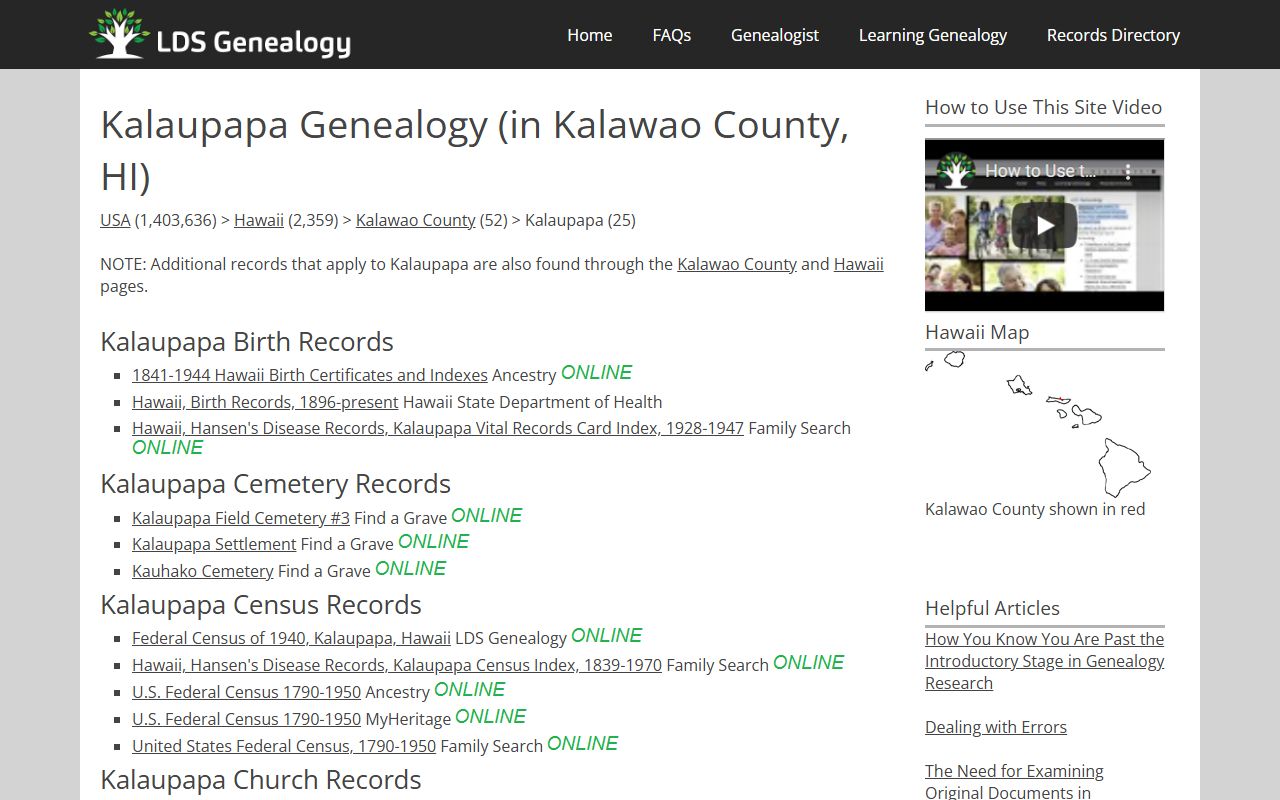
The FamilySearch wiki for Kalawao County covers historical vital records and genealogy resources for the Kalaupapa settlement, including indexes for births, marriages, deaths, and related records that can help trace family history connected to divorce decree filings in the area.
How to Request Divorce Decree Copies for Kalawao County
To get a copy of a Kalawao County divorce decree, you need to go through the Second Circuit Family Court. There is no local office in Kalaupapa or anywhere else on the Makanalua Peninsula. You have two main paths: contact the court by phone or mail a written request. In-person visits are possible for those who can reach Wailuku, but that is not practical for most people with ties to Kalawao County.
For a mail request, write to the Second Circuit Family Court at Hoapili Hale, 2145 Main Street, Wailuku, HI 96793. Your letter should include the case number (if you have it), the full names of both parties, the approximate year the divorce was filed, and the type of document you need. If you want a certified copy, say so clearly. Payment must be a money order or cashier's check made out to "State Director of Finance." Personal checks are not accepted. Standard copy fees apply under the court's schedule. Certified copies carry an additional fee.
By phone, the Chief Court Administrator can be reached at (808) 244-2929. Staff can confirm whether a case exists and explain the process for getting copies. They do not give legal advice, but they can walk you through what is needed to complete your request. For cases involving property or children, certified copies of the decree are often required for legal or financial transactions, so it is worth confirming that the copy you receive has the court's official seal.
Kalawao County and the Kalaupapa Settlement
Kalawao County was formed in 1903 from land that had been part of Maui County. The name Kalawao means "mountain-side wild woods" in Hawaiian. The county exists because of the Kalaupapa settlement, which the Hawaiian government established in 1866 as a place to isolate people diagnosed with leprosy, known today as Hansen's disease. The settlement sat on the flat peninsula below the high sea cliffs on the north side of Moloka'i, a location that made it hard to leave and easy to contain.
The history of leprosy law in Hawaii directly touched divorce records. In 1873, the year Dr. Gerhard Hansen identified the germ that caused leprosy, Hawaii law recognized the disease as legal grounds for divorce. A spouse who had been sent to Kalaupapa could become the subject of a divorce action by the partner who remained on the outside. This was one of the earliest intersections of public health law and family law in the islands, and it left a distinct mark on the divorce records tied to the settlement. These cases became part of the broader circuit court record maintained in Wailuku.
By 1890, most of the settlement's population had shifted from the original Kalawao area to Kalaupapa on the western edge of the peninsula. Children born at Kalaupapa were separated from their parents beginning in 1908, a policy that also generated its own set of vital records. In 1946, the sulfone drug Promin was given to patients at the settlement. The drug worked. Patients were no longer contagious and could leave quarantine. The forced isolation that had defined life at Kalaupapa for eighty years began to end. Today the peninsula is a national historical park, and the unique record-keeping practices tied to the settlement's history are preserved across several archives.
Because of this background, records connected to Kalawao County can be scattered. Vital records from the settlement period were sometimes kept separately from standard circuit court files. For anyone researching family history tied to Kalaupapa, the records require checking more than one source.
Historical Divorce Records for Kalawao County
The Second Circuit Court holds historical divorce records dating back to the mid-1800s. For the Second Circuit, which covers Maui and Kalawao counties, case files from 1848 to 1900 are catalogued under microfilm reference MFL 54, covering cases A1 through A319. These are paper-based records and are not available through eCourt Kokua. To access them, contact the Hawaii State Archives at 364 S. King Street, Honolulu. The phone number is (808) 586-0329. Archives staff can help locate specific files and explain how to request copies of historical records.
For genealogical research tied to the Kalaupapa settlement specifically, FamilySearch maintains several relevant collections. These include the Kalawao County, Hawaii Genealogy wiki, which lists available record sets for the area. Related collections include Hawaii birth certificates and indexes from 1841 to 1944, Hawaii death certificates and indexes from 1841 to 1942, Hawaii marriage certificates and indexes from 1841 to 1944, and the Hawaii Hansen's Disease Records, Kalaupapa Vital Records Card Index covering 1928 to 1947. These records reflect the settlement's distinct record-keeping history and can be useful for tracing individuals who were sent to Kalaupapa or who had family members there.
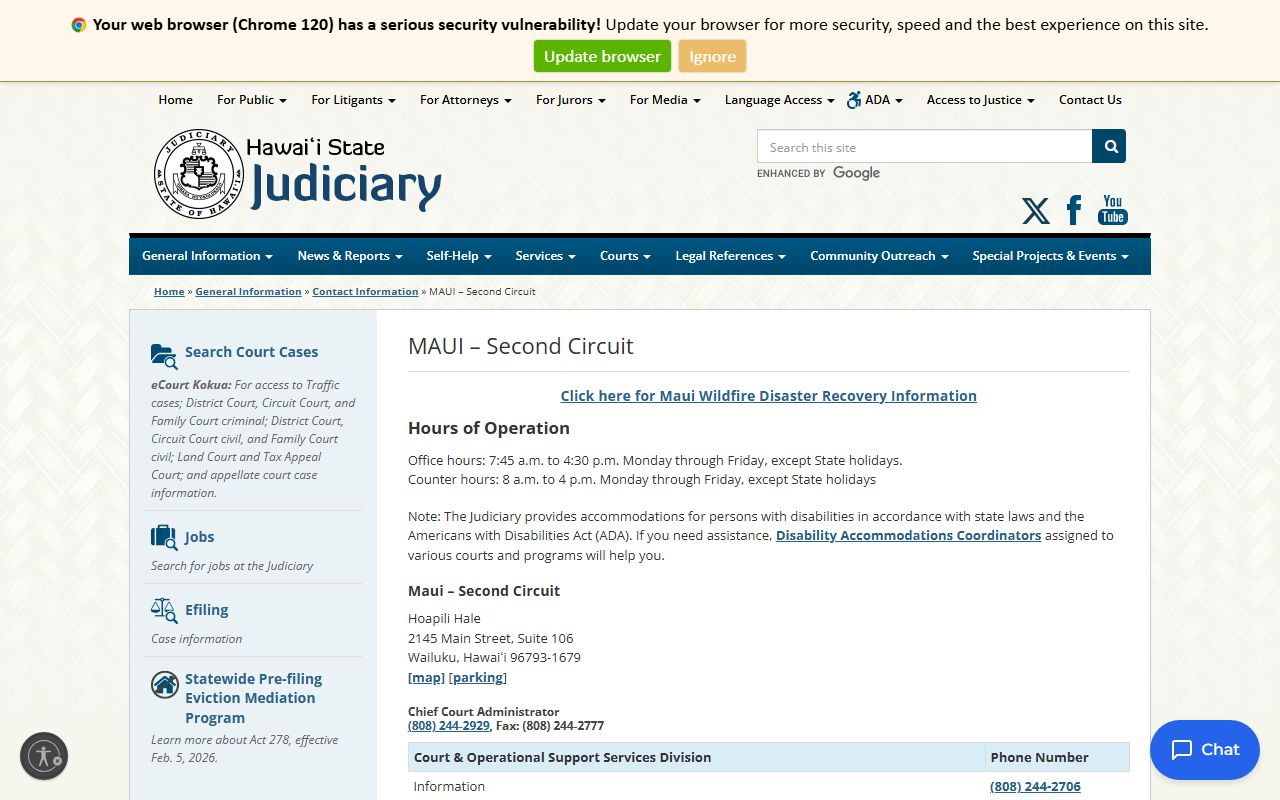
The Second Circuit Court contact page on the Hawaii Judiciary website provides address, phone, and hours information for Hoapili Hale in Wailuku, the courthouse that handles all Kalawao County divorce decree filings and record requests.
Statewide vital record registration in Hawaii began in 1842, though few records survive from before 1896. General compliance with registration requirements was not common until around 1929. For Kalawao County specifically, court and land records begin around 1905. If you are looking for a record from before that date, the State Archives and FamilySearch are your best starting points. Records may also be fragmented or incomplete given the settlement's unusual history.
Legal Help and Self-Help Resources
The Second Circuit Court operates a Maui Self-Help Center that serves people navigating divorce cases without an attorney. The center is located at Hoapili Hale, 2145 Main Street, Wailuku, HI 96793. It is open on Thursdays from 9 a.m. to noon. Staff at the center can help you understand court forms, explain what documents you need, and walk you through the filing process. They cannot give legal advice, but they can answer questions about the process itself.
For residents of Molokai and nearby areas who cannot travel to Wailuku, the Self-Help Center offers access by telephone during open hours. The phone number is (808) 463-1360. The center does not accept voice messages, so you need to call while the center is open on Thursday mornings. This is the most direct way for someone in Kalawao County's geographic area to get procedural help without making the trip to Maui.
The Legal Aid Society of Hawaii has a Maui office at 24 North Church Street, Suite 401, Wailuku, HI 96793. The direct line is (808) 244-3731. Their statewide number is (808) 536-4302. Legal Aid helps low-income individuals with family law matters, including divorce decree filings. Volunteer Legal Services Hawaii can be reached at (808) 528-7046. Both organizations serve the Second Circuit area, which includes Kalawao County. If you are not sure whether you qualify for free legal help, call and ask. Eligibility is based on income and the nature of your case.
Are Kalawao County Divorce Records Public?
Most Kalawao County divorce decree records are public, but the level of access depends on what part of the file you want. Basic case information, including party names, case number, filing date, and case status, is open to anyone. This right is grounded in Hawaii Revised Statutes Chapter 92F, the Uniform Information Practices Act, which gives the public the right to access government records held by state agencies and courts.
The full decree and supporting financial documents are restricted. Income statements, asset disclosures, and tax records in the file are available only to the parties, their attorneys, and others with a demonstrated direct interest in the case. If a judge has ordered a record sealed, it does not appear in public searches at all. Under HRS Section 580-41, Hawaii is a no-fault divorce state. The only recognized ground for divorce is that the marriage is irretrievably broken. This means Kalawao County divorce records do not contain fault allegations or conduct claims of the kind that appear in records from states with fault-based systems.
For historical records tied to the Kalaupapa settlement, access can be more complicated. Some records from that period were kept separately from standard court files and may have their own access rules. Contact the Hawaii State Archives directly if you are trying to reach records from the settlement era. The Archives can tell you what is available and what the process is for requesting copies.
Note: If you believe a court record has been improperly withheld, you can submit a UIPA request. The Office of Information Practices at the Hawaii Attorney General's office handles disputes about access to government records statewide.
Nearby Counties
Kalawao County has no qualifying cities of its own. Its residents are served by the Second Circuit Court in Maui County. The other Hawaii counties each handle divorce decree records through their own circuit courts.