
Schofield Barracks Divorce Decree Records
Schofield Barracks is a U.S. Army installation on central Oahu, and service members stationed here can access divorce decree records and file for divorce through the Hawaii First Circuit Family Court. Hawaii law specifically protects the right of military personnel to meet residency requirements even while living on base under orders. This page covers where Schofield Barracks residents file, how to search for divorce decrees using eCourt Kokua, how to request copies from the clerk, and what free legal help is available for military families on Oahu.
Schofield Barracks Quick Facts
Divorce Filing for Schofield Barracks Residents
Schofield Barracks falls within Honolulu County and is served by the Hawaii First Circuit. All divorce cases on Oahu go through the First Circuit Family Court. The main family court location is the Kapolei Judiciary Complex at 4675 Kapolei Parkway, Kapolei, HI 96707. The main phone number is (808) 954-8000. This is the office that accepts petitions, schedules hearings, and issues final divorce decrees for Schofield Barracks and the surrounding central Oahu area.
There is a district court closer to base. The Oahu First Circuit District Court in Wahiawa sits at 1034 Kilani Avenue, Wahiawa, HI 96786, and can be reached at (808) 534-6200. That office handles traffic cases, small claims, and other district-level matters. Divorce is not among them. If you go to the Wahiawa district court for help with a divorce, staff will refer you to Kapolei. It is worth knowing this before you make the drive.
For mail requests or written correspondence related to First Circuit divorce records, use the Ka'ahumanu Hale address: 777 Punchbowl Street, Honolulu, HI 96813. Some record requests and administrative matters are processed at that downtown Honolulu location. Kapolei handles the hearings and in-person filing. Punchbowl handles much of the administrative side.
Military Residency Rules Under HRS § 580-1
Hawaii law addresses military residency directly. Under HRS § 580-1, a person residing on a military or federal installation in Hawaii, or present in the state under military orders, is not barred from meeting the residency requirements for divorce. This is a key protection for Schofield Barracks service members and their families. Living on a federal installation does not disqualify you from filing for divorce in Hawaii courts.
To file in the First Circuit, a person must have lived in Hawaii for at least six months and in the First Circuit itself for at least three months. For military residents at Schofield Barracks, time spent on base under orders counts toward physical presence. This means a soldier or their spouse stationed at Schofield for six months or more generally meets the basic residency test. If there is any question about your specific situation, the Ho'okele self-help center can help you work through the details.
The statute applies to both the service member and their spouse. If a spouse came to Hawaii with the service member and has lived at Schofield Barracks for the required period, they may also file. The court looks at actual physical presence in the state, not domicile on paper. Time on base counts the same as time in any other part of the state or circuit.
The Hawaii State Judiciary has published a guide on divorce facts that covers residency rules in plain language. It does not replace legal advice, but it gives Schofield Barracks residents a starting point for understanding what the court expects before filing.
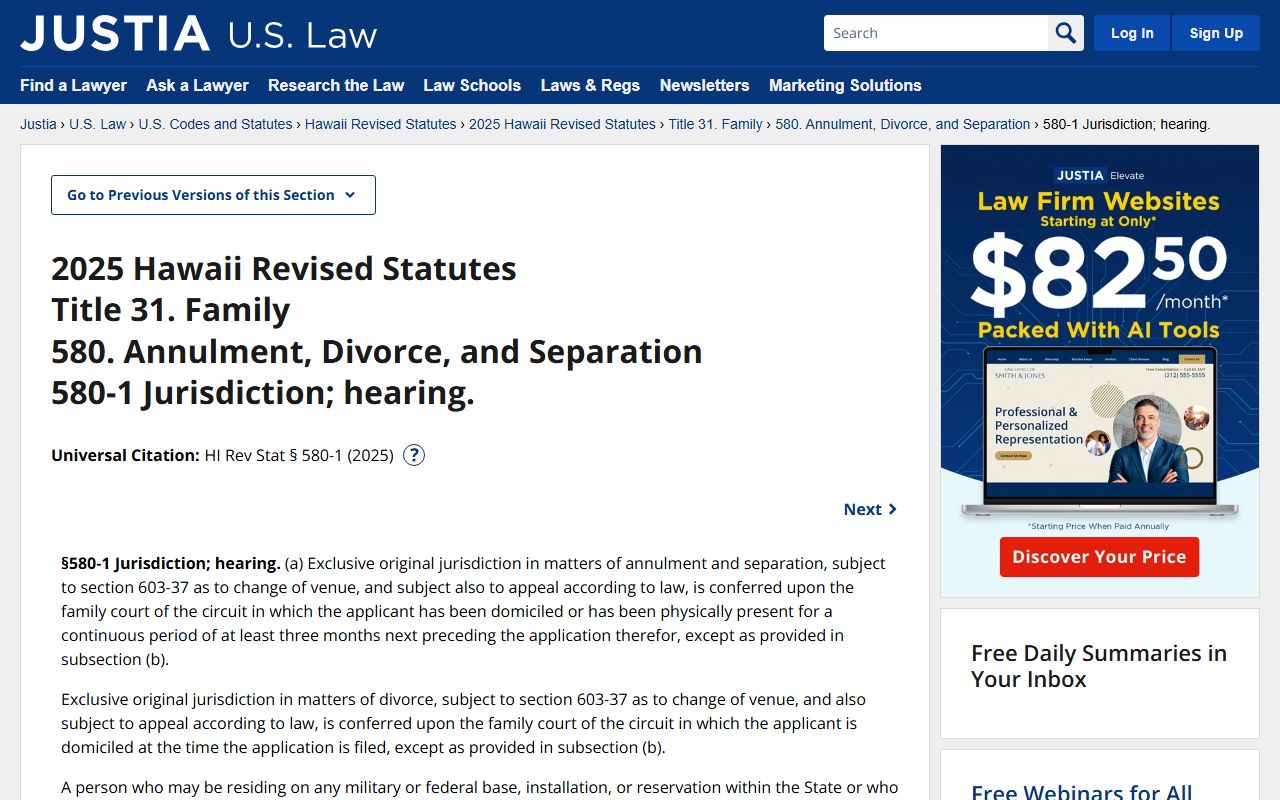
HRS § 580-1 is the statute that establishes residency rules for divorce in Hawaii, including the specific provision that protects military families living at Schofield Barracks and other federal installations.
Searching Divorce Decree Records Online
The Hawaii State Judiciary provides eCourt Kokua, a free public case search tool. Schofield Barracks residents can use it to look up divorce decree records filed in the First Circuit without going to the courthouse. The search portal is at courts.state.hi.us. You do not need an account or a login to search.
To find a Schofield Barracks divorce case, select "Oahu - First Circuit Family Court" from the court dropdown menu. Then search by one of the party names. The case type is listed as "DV - Divorce" in the system. Results show the case number, party names, filing date, and the current status of the case. You can also see scheduled hearing dates and some docket entries. Full case documents are not available online. For those, you must contact the clerk or visit in person.
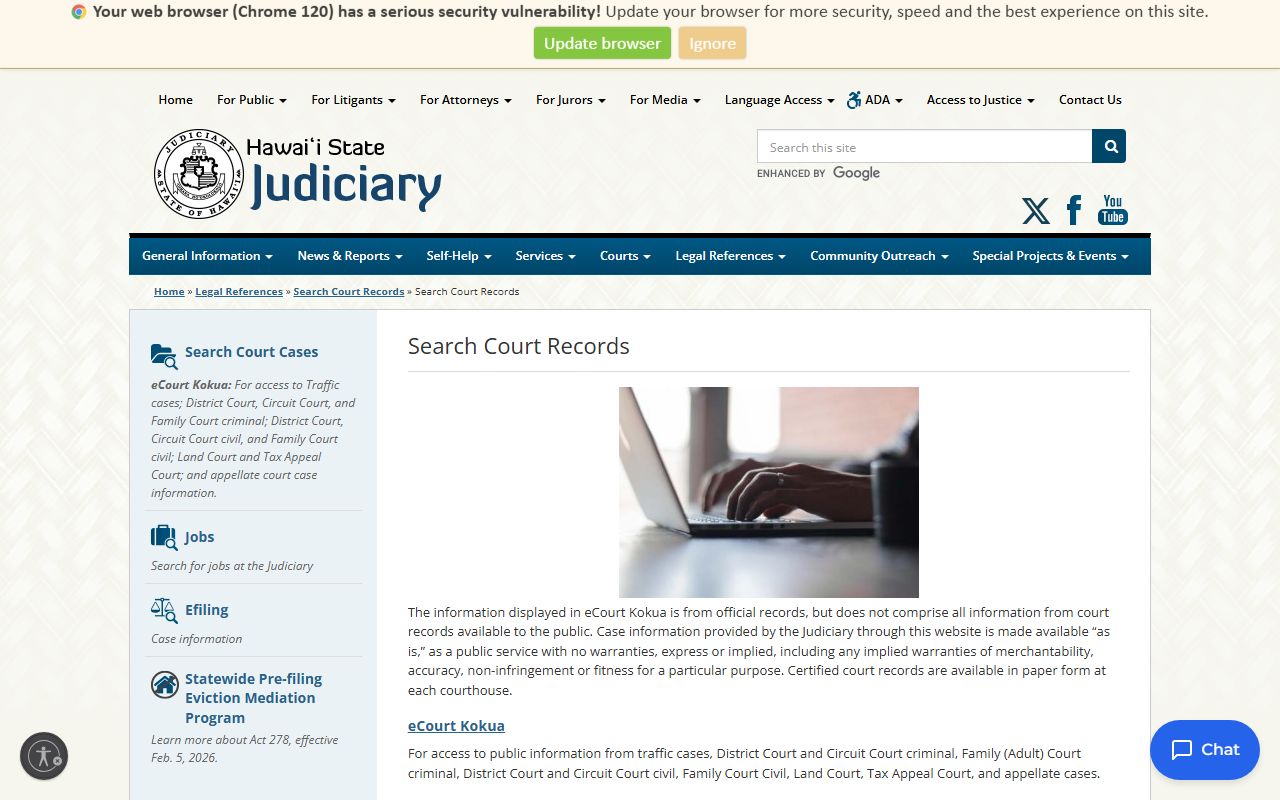
eCourt Kokua is the official Hawaii court records search tool. Schofield Barracks residents can use it to find First Circuit divorce decree case numbers, filing dates, and case status without visiting the courthouse.
Getting Copies of a Divorce Decree
Once you have the case number from eCourt Kokua, getting a copy is straightforward. Visit the First Circuit Family Court clerk at Kapolei and bring a valid photo ID. Staff can look up the case by name if you do not have the number. Plain copies and certified copies are both available. Certified copies cost a little more and are what you need for legal purposes like a name change, a property transfer, or a government form that asks for proof of divorce.
For service members or spouses who cannot easily get to Kapolei, mail requests are an option. Write to the First Circuit Family Court, 777 Punchbowl Street, Honolulu, HI 96813. Include both parties' names, the approximate year of divorce, and the case number if you have it. State whether you need a plain or certified copy. Enclose a check or money order payable to the State of Hawaii, and include a self-addressed stamped envelope so the clerk can return the document. Mail requests take longer than in-person visits, so plan for that if you have a deadline tied to a military move or a legal proceeding.
The Hawaii Uniform Information Practices Act, under HRS § 92F, governs public access to court records. Divorce decrees are generally public. Parts of a case file can be sealed by a judge, but most standard decrees are available to anyone who submits a proper request. HRS § 580-41 addresses how divorce records are maintained and accessed under state law.
Note: As of February 1, 2026, the Hawaii Department of Health no longer maintains divorce records. All requests for copies of a divorce decree now go directly to the First Circuit Family Court clerk at Kapolei or the Punchbowl Street address.
Self-Help and Legal Resources at Kapolei
The Hawaii courts run a self-help center called Ho'okele at the Kapolei Judiciary Complex. Schofield Barracks residents are served by this office since all Oahu divorce cases go through Kapolei. You can reach Ho'okele at (808) 954-8290. Staff help people find the right forms, understand how the filing process works, and figure out what the court needs at each stage. They do not give legal advice, but the guidance they offer is practical and useful for anyone navigating the process without a lawyer.
The Kapolei courthouse also hosts the KAJR program, which stands for Kapolei Alternative Justice Resources. KAJR meets on the 1st and 3rd Thursdays of each month. The program connects people with community services, legal aid referrals, and support resources in one convenient courthouse-based setting. Schofield Barracks residents who can get to Kapolei on one of those Thursdays can walk in and get referrals without an appointment.
If children are part of the divorce case, Kids First Hawaii is a resource the court may require you to use. Their line is (808) 954-8280. Kids First runs programs that help parents understand how divorce affects children and how to navigate custody arrangements. Some Family Court judges will not finalize a divorce where children are involved until both parents complete a Kids First program. Ask the clerk at Kapolei when you file if this applies to your case.
Military families at Schofield Barracks also have access to legal assistance through the Army's on-base legal office. JAG officers can help service members understand their rights under state and federal law and refer them to civilian attorneys if the case requires it. On-base legal help is a good first call for active duty personnel who are just starting to think about a divorce.
Hawaii No-Fault Divorce Law
Hawaii is a no-fault divorce state. The court does not require either spouse to prove that the other did something wrong. The standard ground for divorce is that the marriage is irretrievably broken. This is what most Schofield Barracks cases use. The filing spouse states that the marriage has broken down without a reasonable chance of reconciliation, and the court accepts that as sufficient to move forward. Neither party has to present evidence of fault to get a divorce granted.
The divorce decree that comes out of the case is the official legal record of the dissolution. It covers property division, any support orders, and custody and visitation arrangements if there are children. Schofield Barracks residents often need the decree for military-related purposes, like updating DEERS records, adjusting housing allowance, or dividing retirement benefits under the Uniformed Services Former Spouses' Protection Act. A certified copy from the First Circuit clerk is what most agencies and processors will ask for.
The forms used at the First Circuit are published on the Hawaii courts website at courts.state.hi.us. They cover the petition, financial disclosure, and the proposed divorce decree. If you and your spouse agree on the terms, you can work through the uncontested divorce packet together. If the case is contested, the process takes longer and legal help is strongly recommended.
Nearby Cities
These communities are near Schofield Barracks and use the same First Circuit Family Court for divorce filings.
Honolulu County Divorce Records
Schofield Barracks is in Honolulu County. All divorce cases for Oahu go through the First Circuit Family Court. The county page covers the full court system, additional resources, and how to access Honolulu County divorce decree records.