
Find Divorce Decree Records in East Honolulu
East Honolulu divorce decree records are held by the First Circuit Family Court, which covers all of Oahu and is part of Honolulu County. If you live in East Honolulu and need to file for divorce, get a copy of a divorce decree, or search for an existing case, the Kapolei Judiciary Complex is your primary contact point. This guide walks through where to file, how to search records online, how to request copies, and what self-help and legal aid programs are available to East Honolulu residents.
East Honolulu Overview
Where East Honolulu Residents File for Divorce
East Honolulu residents file for divorce at the Family Court of the First Circuit. The primary filing location is the Kapolei Judiciary Complex, also known as the Ronald T.Y. Moon Courthouse. The address is 4675 Kapolei Parkway, Kapolei, HI 96707, and the main number is (808) 954-8000. This is where new divorce petitions are filed, hearings are scheduled, and most divorce decree records can be accessed.
The Kapolei courthouse handles all Family Court matters for Oahu, including cases from East Honolulu. The court processes divorce filings under Hawaii's Family Court system, which is part of the First Circuit. You will need to file your case here even if you live on the far east side of the island. The drive can take time, so plan accordingly when scheduling visits.
The Oahu First Circuit District Court also operates at the Kapolei location. Its phone number for the Waianae branch is (808) 954-8575. While the District Court does not handle divorce cases directly, it is in the same complex and may be relevant if your case involves related matters such as restraining orders or domestic violence petitions.
Note: Bring a valid photo ID and your case number when visiting the courthouse to request divorce decree records or drop off paperwork.
Searching East Honolulu Divorce Decree Records Online
The Hawaii Judiciary provides a free public records search tool called eCourt Kokua. East Honolulu residents can use it to find divorce decree case information without visiting the courthouse. The search pulls from the First Circuit Family Court database, which covers all of Oahu including East Honolulu.
Go to the eCourt Kokua case search portal and select "Oahu - First Circuit Family Court" from the court list. You can search by party name or case number. Use the case type filter and choose "DV - Divorce" to narrow results to divorce cases. The system returns case names, status, filed documents, and upcoming hearing dates. It does not show full document text, but it confirms whether a case exists and is active or closed.
The eCourt Kokua portal is the fastest way to confirm whether a divorce decree exists for a specific case and to get the case number before making an in-person or mail request.
Older East Honolulu divorce decree records may not appear in the online system. Records from before eCourt Kokua went live must be requested directly from the courthouse or, for very old cases, from the Hawaii State Archives at 364 S. King Street in downtown Honolulu.
Requesting Copies of a Divorce Decree
To get a copy of a divorce decree in East Honolulu, visit the First Circuit Family Court at the Kapolei Judiciary Complex. Bring a valid photo ID and your case number if you have it. Plain copies are available for a per-page fee. Certified copies cost more and carry the court's official seal, which many agencies require for legal purposes like name changes, passport updates, or remarriage applications.
Mail requests are also accepted. Send a written request to the First Circuit Family Court at 777 Punchbowl Street, Honolulu, HI 96813-5093. Include the names of both parties, the approximate year of the filing, and your case number if known. Enclose a check or money order for the copy fees and a self-addressed stamped envelope for return mail. Processing by mail typically takes more time than in-person requests. If you need the decree quickly, visiting the courthouse in person is the better option.
As of February 1, 2026, the Hawaii Department of Health no longer issues divorce certificates. Records from 1951 to 2002 that were previously available through DOH must now be requested from the First Circuit Family Court. If you have tried DOH and received no response, contact the court directly at (808) 954-8000.
Self-Help Resources at Kapolei Courthouse
East Honolulu residents who want to handle their own divorce case have solid support at the Kapolei Judiciary Complex. The Ho'okele Family Court self-help center is located inside the courthouse at 4675 Kapolei Parkway. Call (808) 954-8290 to reach the center. Staff can help you find the right forms, explain court procedures, and answer basic questions about the process. They do not give legal advice, but they can prevent you from making costly procedural errors.
The Kokua Aku, Just Resolve (KAJR) program holds walk-in mediation clinics at Kapolei on the first and third Thursdays of each month from 11:30 a.m. to 1:30 p.m. This program is helpful if you and your spouse need to work out an agreement but want some structure and neutral assistance. Mediation at KAJR is free and does not require an attorney.
Official divorce forms for East Honolulu cases are available for free at the Hawaii Judiciary's Oahu family court forms page. If your case involves children, you must complete the Kids First program before the court will sign off on the divorce. Kids First can be reached at (808) 954-8280. Their website at kidsfirsthawaii.com has class schedules and registration information. This requirement applies to all divorces in Honolulu County where minor children are involved.
The Hawaii Courts also publish a plain-language divorce facts guide. You can access it at courts.state.hi.us. It covers the basic steps, timelines, and what to expect from start to finish.
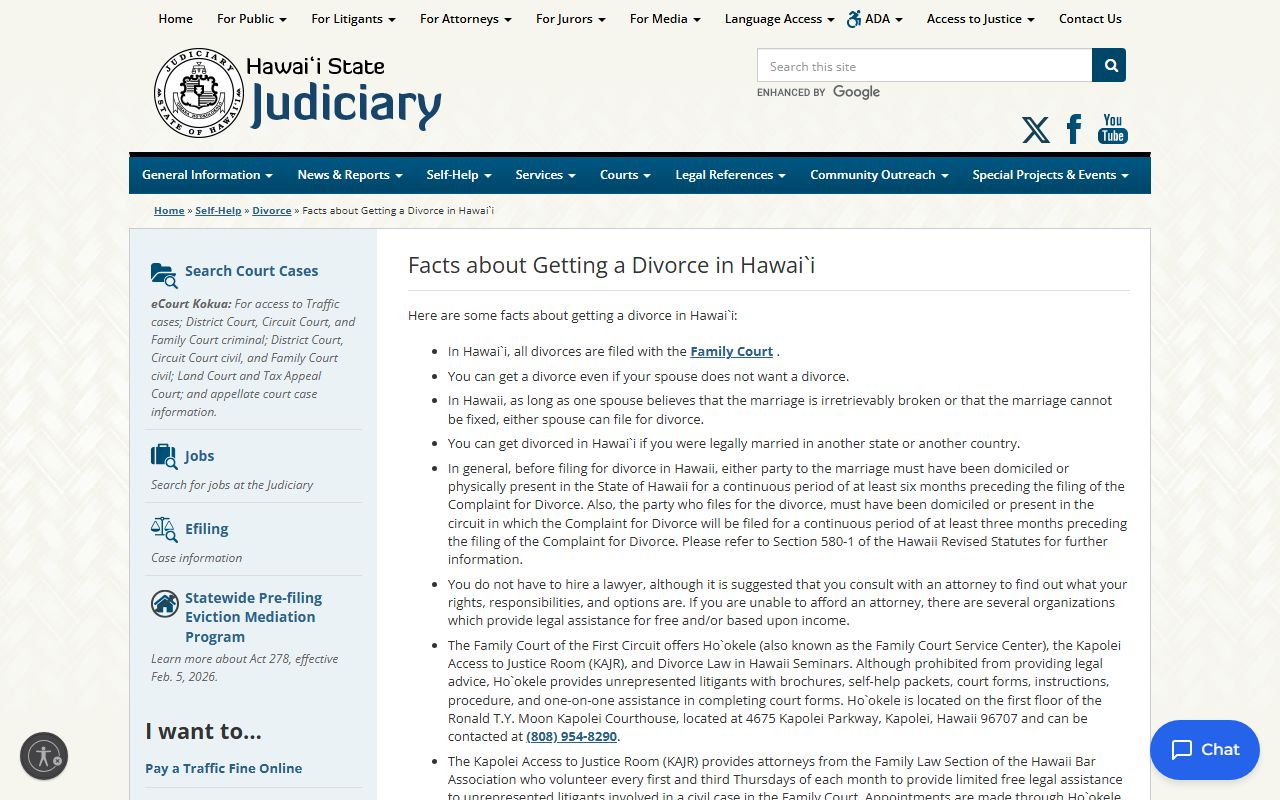
The Hawaii divorce facts page is a straightforward resource for East Honolulu residents who want to understand the process before they walk into the Kapolei Family Court.
Legal Aid for East Honolulu Residents
Two main organizations provide free or low-cost legal help to East Honolulu residents who need assistance with divorce cases. Both serve Honolulu County and handle family law matters including divorce, custody, and property division.
The Legal Aid Society of Hawaii (LASH) offers legal services to people who meet income guidelines. Call (808) 536-4302 to reach their intake line. LASH handles family law cases including divorce filings, protective orders, and related matters. They can help you complete forms, prepare for hearings, or in some cases provide full representation. Their services are free to those who qualify, and staff can tell you quickly whether your case and income level fit their eligibility rules.
Volunteer Legal Services Hawaii (VLSH) is another option. Their number is (808) 528-7046. VLSH connects low-income clients with volunteer attorneys who provide free legal help. They handle divorce cases on a case-by-case basis, and their volunteer lawyers include experienced family law practitioners. Both LASH and VLSH are good first calls if you need legal guidance and cannot afford a private attorney for your East Honolulu divorce case.
Hawaii Law and the Divorce Decree Process
Hawaii is a no-fault divorce state. You do not need to prove that one spouse did something wrong. Under HRS section 580-1, the main grounds for divorce in Hawaii are that the marriage is irretrievably broken. Both spouses can agree to this, or one can assert it alone. The court can also grant a divorce based on other grounds listed in the statute, but most East Honolulu cases use the no-fault standard.
To file for divorce in Hawaii, at least one spouse must have been a resident of the state for six months before filing. Honolulu County is the right venue if you or your spouse lives anywhere on Oahu, including East Honolulu. You do not need to have lived in the county for any particular period beyond meeting the state residency rule.
The final divorce decree is the court order that legally ends the marriage. Under HRS section 580-41, the decree takes effect when the judge signs and files it. It covers property division, custody and support if children are involved, and any other agreed or contested terms. A certified copy of the divorce decree is the official proof that the marriage ended. It is what banks, the Social Security Administration, passport offices, and other agencies will ask to see.
Hawaii uses an equitable distribution standard for marital property. The court does not automatically split things fifty-fifty. Instead, the judge looks at what is fair given the circumstances. Couples who agree on property terms can submit a settlement agreement, and the court will usually accept it if it appears reasonable and both parties signed it voluntarily.
Note: The UIPA statute at Chapter 92F governs public access to Hawaii court records, including divorce decree filings from the First Circuit Family Court in Honolulu County.
Nearby Cities
These cities are in Honolulu County and use the First Circuit Family Court for divorce filings.
Honolulu County Divorce Decree Records
East Honolulu is part of Honolulu County. The county page covers the full First Circuit Family Court system, how to search countywide divorce decree records, and resources that apply to all Oahu communities.